By Evelyn Jacobo Santana
“Today is a triumph for freedom as huge as any victory that has ever been won on any battlefield.”
President Lyndon B. Johnson, signing of the Voting Rights Act on August 6, 1965
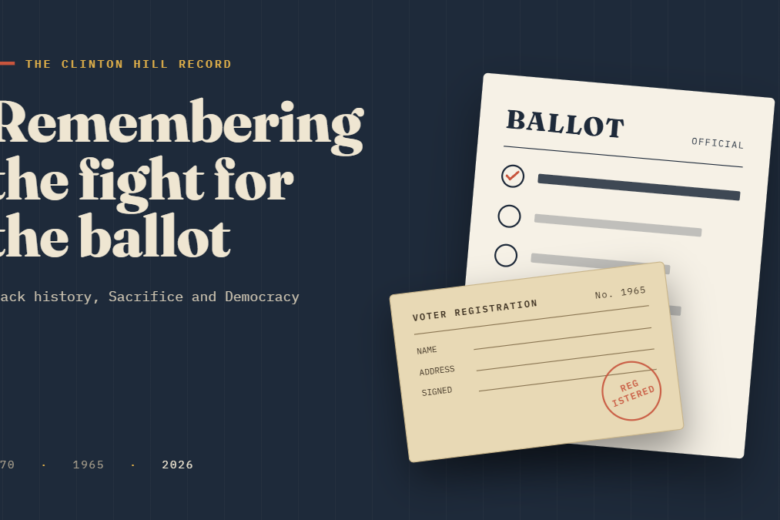
Partnering with Clinton Hill Community Action and their Neighborhood History Project, Charles M. Payne, Rutgers-Newark professor of Africana Studies and Director of the Joseph C. Cornwall Center for Metropolitan Studies, discussed the history of Black voting rights and the struggles that previous generations of Black Americans endured to secure political representation in America during a community conversation on October 20, 2026, at the Gilbert-Gant Arts Collective Black Box Theater.
The lecture, titled “Voting Rights and the Last Expansion on American Democracy,” examined the struggles Black Americans have faced over their voting rights since the ratification of the 15th Amendment in 1870, which states that “The right of citizens of the United States to vote shall not be denied or abridged by the United States or by any State on account of race, color, or previous condition of servitude.” However, its ratification did not put an end to racial discrimination at the polls; the fight was far from over. For example, the Ku Klux Klan, a white supremacist terrorist organization, used violence to intimidate African Americans, particularly when it came to voting. Payne pointed to Hartman Turnbow, a Mississippi farmer and local activist. The KKK attacked Turnbow’s house at night with firebombs and firearms. Like other Black activists in the South, he was targeted by people whose goal was to kill him and halt the movement for Black participation at the polls.
In his lecture, Payne traced the history of the civil rights movement from the 1940s to the 1960s, highlighting the systemic violence and intimidation directed at Black Americans, particularly in the South, as well as the courage of local activists who continued to fight for Black voting rights.
From the NAACP’s legal challenges against segregation to the grassroots effort to educate Black communities and encourage voter participation, the struggle against discrimination and for representation in the U.S. required sustained organizing and resistance. Payne emphasized the importance of these local efforts, illustrating how the fight for voting rights offers lessons for today’s political mobilization and for the political education of younger generations who, over time, grow increasingly removed from the struggles that won them those rights. Payne shared an example of younger generations taking their voting rights for granted with a story from Myrlie Evers-Williams, an iconic author and activist who spent decades on the front lines of the civil rights movement in Mississippi alongside her husband, Medgar Evers. Years after Medgar Evers was assassinated by a white supremacist, Myrlie and their son had a conversation about voting, with the son expressing apathy. Payne shared her response: “She gives him his father’s registration card, which she had been holding on to since he got shot, with the father’s blood still on it. She has not had any trouble with that boy since.” Younger generations, even those whose families were directly on the front lines of the civil rights movement, still need to be reminded of the past to better understand the rights they have today.
After his lecture, Payne sat down with the Clinton Hill Record and expanded on the importance of preserving Black history and making sure younger generations understand the sacrifices behind the rights they inherit. When asked if he believed progress was permanent, Payne emphasized that the fight for equality is ongoing and that advances in civil rights should not be taken for granted, as “progress is never as permanent as many believe.”
When asked how young people can be mobilized to vote today, Payne explained that purely moralizing appeals (“abstaining from voting is a betrayal of the ancestors”) accomplish very little in the long run. Rather, he said, “You start by giving the young people a chance to talk about how they feel…A lot of what we need to do is find out what they care about and then help them understand the connection between what they care about and political activity as we understand it.” To Payne, it is crucial to listen to young people themselves and provide spaces for open debate on topics that matter to them, so they can understand the consequences of not voting or not being involved in politics.
During the open discussion that followed the lecture, audience members offered their perspectives on growing political disengagement among younger generations, highlighting the incomplete teaching of civil rights history in schools despite laws like New Jersey’s Amistad Law. Others urged young people to get involved in local grassroots initiatives in New Jersey, such as the New Jersey Black Empowerment Coalition (NJBEC), the New Jersey Million Voters Project (MVP), and other civil rights initiatives that aim to encourage political participation not just among youth, but among Black communities as a whole.
While many believe the fight for civil rights ended with the passing of the Civil Rights Act of 1964 and the Voting Rights Act of 1965, Payne’s discussion serves as a reminder that political progress is neither automatic nor guaranteed. The generations who fought against racial injustice, intimidation, and systemic racial violence helped expand American democracy, but preserving that progress requires continued civic engagement from older and younger generations alike. As Payne highlighted, it is not enough to remind youth of past struggles; it also requires showing them how political decisions affect their present and future.
To reach people who would otherwise be apathetic about voting and get them engaged in politics, Payne said, is to “build on the things that people are used to doing, in places that they are regularly in and get them involved.”